
Commission Votes No on AI Data Center Before Packed Crowd
By: Shelia Mader
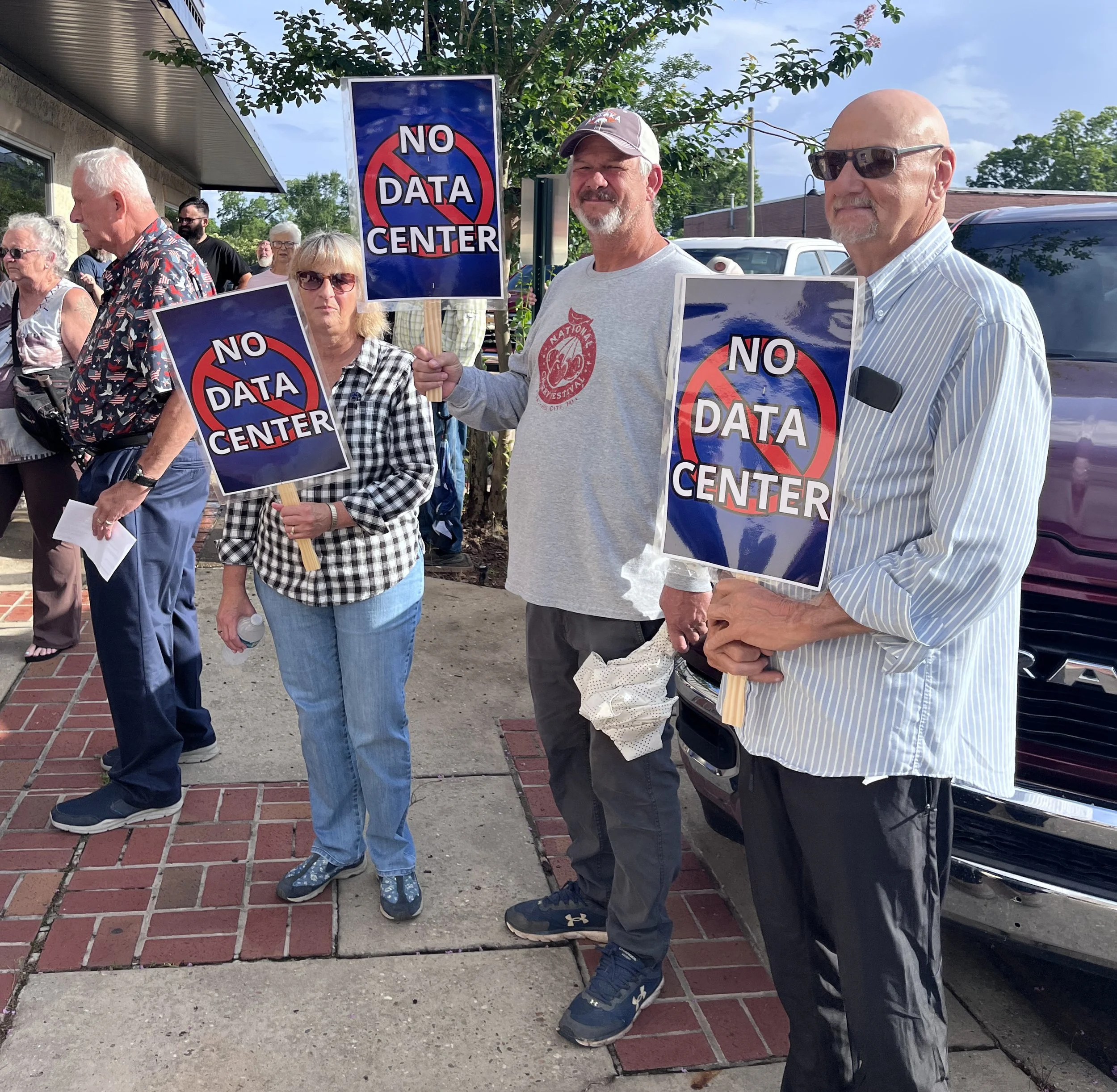
The Jackson County Board of County Commissioners faced a packed chamber and overflowing crowd Tuesday night as residents from Jackson and surrounding counties voiced overwhelming opposition to the possibility of a large-scale AI data center being developed near Compass Lake and the Econfina watershed area. Hundreds attended the meeting, many carrying concerns about groundwater depletion, environmental impacts, infrastructure strain, noise pollution, property values, and the long-term future of the rural communities surrounding the proposed site. The meeting began with commissioners addressing the issue directly before public comment began. Commissioner Donnie Branch opened the discussion by acknowledging the concern in the room and making it clear where he stood. “I want to start off tonight by saying it’s very evident what’s on everybody’s mind here tonight,” Branch said. “I want to say up front that I’m not for this. “Branch then made the motion to impose a one-year moratorium on any AI data center construction or development activity within Jackson County. He explained that the county needed time to protect itself legally while also studying the issue in depth. “There are certain things that have to be done in order for it to be done legally,” Branch said. “We can extend it, we can adapt it, but I think if we start out with the one year and the new law coming into effect July 1, I think we’d be on solid ground.” Attorney Clayton Knowles then explained why the county was pursuing a one-year moratorium rather than an outright permanent ban. Knowles told the board the county needed time for Senate Bill 484, which takes effect July 1, to become active so the county would have stronger legal authority to regulate data centers through the comprehensive plan and land development code. “What I think we need to do is a one-year moratorium,” Knowles said. “That’ll give us enough time to allow Senate Bill 484 to come into effect, which will give the county the ability to regulate these data centers in a more comprehensive manner through the comp plan and the land development code. “Knowles cautioned that attempting to impose a longer moratorium immediately could expose the county to litigation. “I think if we go longer than a year, we can open ourselves up to potential litigation,” he said. “It can always be renewed, it can always be repealed, but moving forward I think the best course of action will be to start with the moratorium. “Knowles also emphasized the county’s need to “do its homework” and create legally defensible regulations. “We’ve got to give the board the opportunity to come through and do this in a manner that’s legal and protects the county from potential litigation moving forward,” Knowles said. Commissioner Edward Crutchfield echoed those concerns while making clear he did not support the project. “My feelings is on it, I’m not for it,” Crutchfield said. “We were elected to do what’s best for the county and what’s best for the citizens. That’s what I want to do. “Crutchfield said the board needed to follow legal guidance while gathering information and evaluating what would ultimately be best for Jackson County. Commissioner Paul Donofro said there was “a lot of information out there” and “a lot of misinformation out there,” but added that based on what he had already seen, the proposal appeared likely to be harmful. “Right now, based on everything I am seeing, more than likely would be a bad thing,” Donofro said. Still, he supported the moratorium as a way for the county to conduct research and avoid unnecessary lawsuits. Commissioner Dr. Willie Spires said the board’s goal was to ensure any action taken was done legally while protecting the county. “We’re not saying we’re going to approve it a year from now,” Spires said. “We’re giving us time to make sure everything is done legally and we’re not exposing the county to a lawsuit. “Chairman Jamey Westbrook delivered perhaps the strongest statement, “I would never vote for it if they had a gun to my head,” Westbrook said. “There’s too many unnamed things that we don’t know about, and I’m not going to be for something that I don’t know about.” Branch later clarified that the county would not simply wait a year without action. “We’re not saying we’re going to impose the moratorium tonight and wait for a year to do this,” he said. “We’ll start to work on it now to see what things that we will say. That just gives us time to work on it.” The motion passed unanimously in a 5-0 vote. Following the vote, residents from across Jackson, Washington, Bay, and Calhoun counties addressed commissioners for nearly two hours, with speaker after speaker urging county leaders to permanently stop any future AI data center development.
Among the speakers drawing particular attention was Benjamin Howard Odom, president broker of Country Land Realty in Marianna. Odom called the issue a defining moment for the county. “Rarely does a defining moment come across the desk of the county commissioner such as this,” Odom said. “The choices you make on this issue will define not only your legacy, but the future of the natural resources of Jackson County that we hold so dear.” Odom warned that AI data centers threaten the region’s natural resources while providing little meaningful economic return. “AI data centers threaten to take all of this for what, 100 jobs that turn into 50 jobs that turn into 25 jobs as AI advances?” he asked. He pointed specifically to concerns about groundwater withdrawal near Compass Lake and questioned whether developers would present unbiased environmental studies. “I certainly wouldn’t rely on the AI data center developers to provide an objective environmental assessment,” Odom said. “They aren’t going to present impartial science. They’re going to give you a sales pitch.” Though he described himself as supportive of economic development, Odom argued that AI facilities do not function like traditional job-producing industry. “This isn’t economic development,” he said. “It’s industrial utility consumption with a press release.” Odom also questioned whether promised tax benefits would materialize. “They promise tax revenue,” he said. “Every town that gets one of these ends up hearing, ‘Well actually there were abatements, incentives, exemptions, credits, depreciation schedules,’ and suddenly the benefits disappear.” He concluded by telling commissioners residents deserved development that benefits local people instead of “the server racks of billionaires. “Another speaker who drew significant response from the audience was Craig Brown, a former software and hardware industry worker who said he moved to Jackson County specifically to escape large-scale industrial development. Brown argued the AI boom was simply the latest technology trend being aggressively marketed. “Every few years the computer industry comes up with a new buzzword,” Brown said. “This is just the latest.” He described AI as largely dependent on massive internet data collection and criticized the enormous utility demands required to operate large AI centers. Brown told commissioners he asked Microsoft Copilot whether AI data centers were environmentally friendly and read portions of the response aloud during public comment. “The first thing was most AI data centers have significant environmental impacts,” Brown said. He highlighted water consumption figures showing some facilities use up to five million gallons of water per day. “The first thing it’s going to do is drain Compass Lake,” Brown warned. “And the next thing it’s going to do is the Econfina River.” Brown also pointed to electrical demands that can rival tens of thousands of homes and accused developers of not being transparent. “This company that’s proposing this data center has not been honest and forthcoming,” he said. “Attempting to pass this project through as a solar farm is dishonest.” During the meeting, several residents raised questions about a new Florida law taking effect July 1 and how it could affect public transparency surrounding negotiations with developers. One speaker warned that under the new law, details involving tax incentives or negotiations with developers could potentially be shielded from public disclosure for a period of time. That concern led to an extended exchange with county officials and the attorney regarding how quickly the county could formally enact the moratorium ordinance and whether any developer could attempt to submit applications before the moratorium became official. Attorney Knowles explained the county still had to complete the legally required ordinance process, including public hearings. “In theory, someone could come in between now and the time the ordinance is passed yet,” Knowles acknowledged. “But you’ve got to pass the ordinance, then you’ve got to advertise that for public hearing.” Commissioners repeatedly assured residents that even if an application were submitted, no development could move forward without county approval. Public comments throughout the evening repeatedly focused on fears over water usage, aquifer depletion, infrastructure strain, environmental contamination, property values, tourism impacts, and preserving the rural nature of the region. Residents described concerns about: Massive groundwater consumption potentially affecting Compass Lake, Econfina Creek, and surrounding wells, increased electrical demand and strain on utility infrastructure, noise pollution from cooling systems and backup generators, heat impacts and industrialization of rural land, potential contamination from cooling systems and wastewater discharge, property value loss for nearby homeowners, limited permanent job creation despite promises of economic development, increased traffic and future overdevelopment, long-term damage to tourism, recreation, and agriculture. Many speakers emphasized they did not want Jackson County to become another overdeveloped region like parts of Central or South Florida. Residents also repeatedly called for additional town hall meetings, public workshops, and citizen committees so the community could remain involved while the county studies the issue over the next year. Several speakers volunteered to assist the county by researching environmental impacts, state regulations, and policies used in other areas of the country. The emotional tone of the meeting remained intense throughout the evening, with residents frequently applauding comments opposing the project and urging commissioners to continue fighting against any future proposal. By the end of the hearing, commissioners repeatedly assured the crowd that the board understood the public’s concerns and intended to continue examining the issue carefully. The one-year moratorium will now move through the county’s formal ordinance process, which will include multiple public hearings before becoming fully enacted.
Following a lengthy public hearing and an hours-long discussion surrounding concerns over proposed AI data center development in Jackson County, County Administrator Jim Dean requested that the board take the next formal legal step toward implementing the temporary moratorium approved earlier in the evening. Dean asked commissioners to schedule a public hearing for June 9 in order to conduct the first reading of the ordinance officially establishing the one-year moratorium on future data center development within the county. “Mr. Westbrook, after the discussion that we’ve just been through, I would request that the board hold a public hearing on June 9th to have the first reading of the ordinance to implement a moratorium on data centers for Jackson County,” Dean said. Chairman Jamey Westbrook then called for a motion and second from the board to move the process forward. Commissioners approved scheduling the public hearing for June 9 at 9 a.m., with the vote passing unanimously.
The action marked the next official procedural step in the county’s effort to formalize the one-year moratorium while commissioners continue researching the potential environmental, economic, and infrastructure impacts associated with large-scale AI data center development in the region.
