
Courthouse Oak Falls, Bellamy’s Legacy Endures
By: Shelia Mader
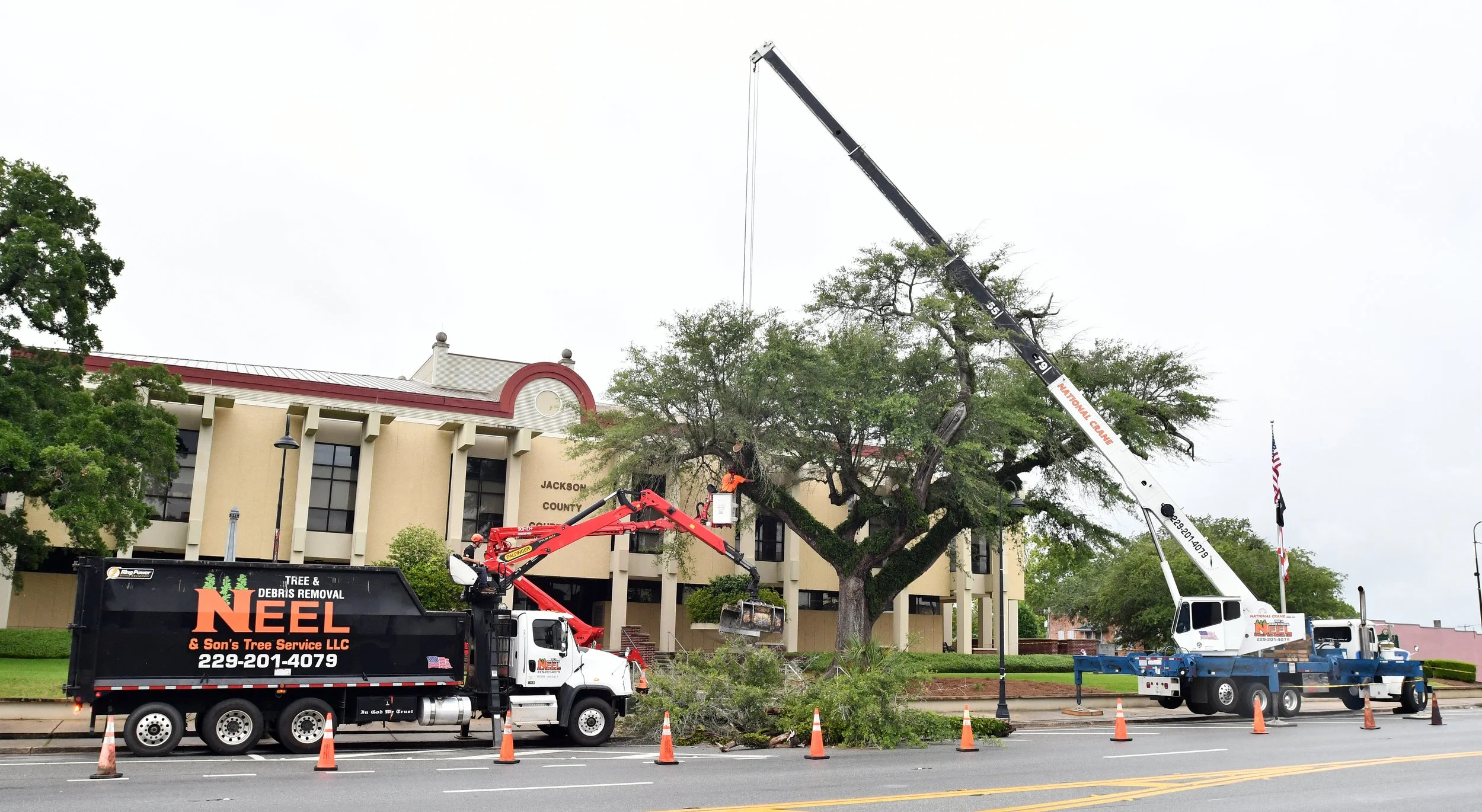
One of the towering live oaks that has stood watch over the Jackson County Courthouse lawn for more than a century and a half has been removed after arborists determined the tree had declined to the point that it posed a public safety risk.
All American Tree Service removed the historic oak after multiple ISA-certified arborists concluded that the tree was suffering from significant decay and could no longer be safely preserved. The cost of the removal $8,000.
In a statement posted prior to the removal, the company acknowledged the emotional significance of the project. "Tomorrow is one of those jobs that reminds us why tree work is about so much more than cutting trees down," the company wrote. "While it's always hard to say goodbye to a tree that has been part of the community for so many years, multiple ISA certified arborists have determined that the tree is in significant decline and that removal is necessary for public safety."
The removal marks the end of a chapter in Jackson County history. Yet for many residents, the story of the tree extends far beyond its branches and roots.
According to local historian Dale Cox, the courthouse oaks were planted in 1873 by Aesop (also spelled Esop) Bellamy, a formerly enslaved man who became one of Jackson County's earliest black businessmen, farmers and horticulturists during the Reconstruction era.
Research published by Cox indicates Bellamy was hired by Jackson County to plant 36 live oak trees around the courthouse square, making the project one of the earliest known county contracts awarded to an African American in Jackson County following the Civil War.
The significance of that achievement cannot be overstated. Just eight years after emancipation, Bellamy was entrusted with helping shape the landscape of the county's most prominent public space. At a time when formerly enslaved Americans faced tremendous barriers to economic opportunity and civic participation, Bellamy's work represented both personal accomplishment and a broader symbol of progress during Reconstruction.
In recent discussions surrounding the courthouse tree, members of the Jackson County NAACP emphasized Bellamy's importance to local history. The organization described Bellamy as a businessman, farmer and horticulturist who lived from 1842 until 1937 and left behind generations of descendants throughout the region.
For many, the courthouse oaks served as living monuments to Bellamy's legacy.
While debates over the tree's removal centered on safety concerns and the condition of the aging oak, supporters of preservation argued that the tree represented a tangible connection to a remarkable chapter of Jackson County's past.
The tree itself may be gone, but Bellamy's contribution remains deeply rooted in the community.
His story reflects the resilience and determination of a generation of African Americans who emerged from slavery and helped build the social, economic and civic foundations of the South during one of the most transformative periods in American history.
For more than 150 years, the courthouse oak stood as silent witness to changing times. It shaded generations of residents, survived wars, economic hardships, social change and natural disasters. Perhaps most importantly, it served as a living reminder of the man who planted it and the opportunities he helped create for those who would follow.
As Jackson County says goodbye to one of its historic oaks, the removal offers an opportunity not only to remember the tree itself, but also to honor Aesop Bellamy, whose work and legacy remain an enduring part of both local and American history.
