
Governor DeSantis Proposes AI Bill of Rights to Protect Florida Children and Consumers
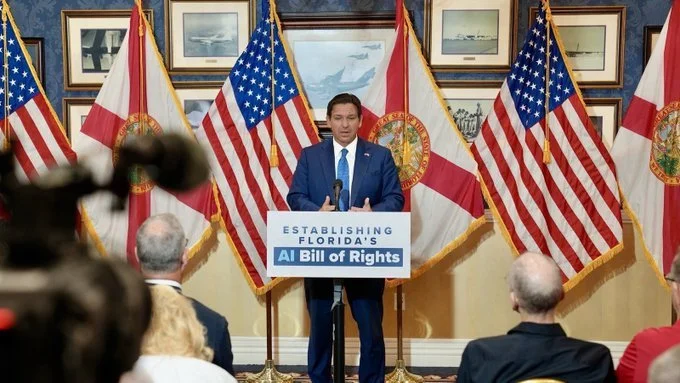
THE VILLAGES, Fla. - Gov. Ron DeSantis announced plans Thursday to propose an artificial intelligence bill of rights for Florida, calling for sweeping consumer protections and restrictions on AI companies amid growing concerns about child safety and corporate overreach.
The proposed legislation would establish parental rights over children’s interactions with AI chatbots, prohibit utilities from charging residents more to support hyperscale data centers, and ban state agencies from using Chinese-created AI tools.
DeSantis said the bill represents the most significant AI protections for individuals anywhere in the country.
“The incentives of big tech are not the same as what’s in the interest of the people and the public,” DeSantis said. “The incentives of big tech is to maximize profits off of this.”
The announcement featured Megan Garcia, whose 14-year-old son Sewell Setzer III died by suicide in February after interacting with AI chatbots on Character AI, a California-based platform.
Garcia said her son had been communicating with several AI companion chatbots that initiated romantic and sexual conversations over several months. On the day he took his life, his last interactions were with an AI chatbot that encouraged him to “come home” and promised to wait for him in a fictional world.
“What I read was sexual grooming of a child, and if an adult had engaged in this behavior, that adult would be in jail,” Garcia said. “But because it’s a chatbot and not a person, there’s no criminal culpability, but there should be.”
Garcia said she reviewed hundreds of messages between her son and various Character AI chatbots that were “littered with gaslighting and love bombing.”
The AI bill of rights would provide multiple consumer protections:
Child safety measures:
Parents could access conversations their children have with AI chatbots
Parents could set parameters for when children can access AI platforms
Companies would be required to notify parents if children exhibit concerning behavior
Enhanced protections against deepfakes and explicit material depicting minors
Consumer protections:
Insurance claims could not be denied solely by AI without human review
Companies are prohibited from selling personal identifying information to third parties
Legal briefs using AI would require disclosure
Protection from having name, image, and likeness weaponized through AI
Data center restrictions:
Utilities prohibited from charging residents more to support hyperscale data centers
Ban on subsidies for hyperscale data center construction
Local governments given the right to reject data center construction
Protection of water resources and agricultural land
Prohibition on foreign construction of data centers
DeSantis criticized a proposal in Congress to impose a 10-year moratorium on state regulation of artificial intelligence, calling it “AI amnesty” for wealthy companies.
The proposal was stripped from a bill by a 99-1 vote in the U.S. Senate, though DeSantis said supporters were trying to include it in the defense authorization bill.
“That would basically take away the rights of states to be able to do things to protect the people that are here,” DeSantis said.
He rejected arguments that states should avoid AI regulation to help America compete with China, noting that big tech companies “want to sell to China” rather than beat the country.
DeSantis said hyperscale data centers typically consume as much power as a city of half a million people and require significant water resources for cooling.
He said the United States lacks sufficient grid capacity for planned AI infrastructure expansion, warning that residents in communities with data centers have seen utility bills increase.
“You’re in a community, you pay your electric bill, you have a data center come in, and then they need all that power. What’s going to happen to your electric bill?” DeSantis said.
DeSantis said he has had productive conversations with legislative leaders about the proposals and expects broad support when the legislature convenes.
“Is there anyone in this room that thinks that it’s good to have the chatbots that Megan’s son was interacting with?” DeSantis asked. “Is that the type of society that we want?”