
When Seconds Count, Jackson County Trains as One. Full-scale exercise at MK-8 tests response from first alert through family reunification
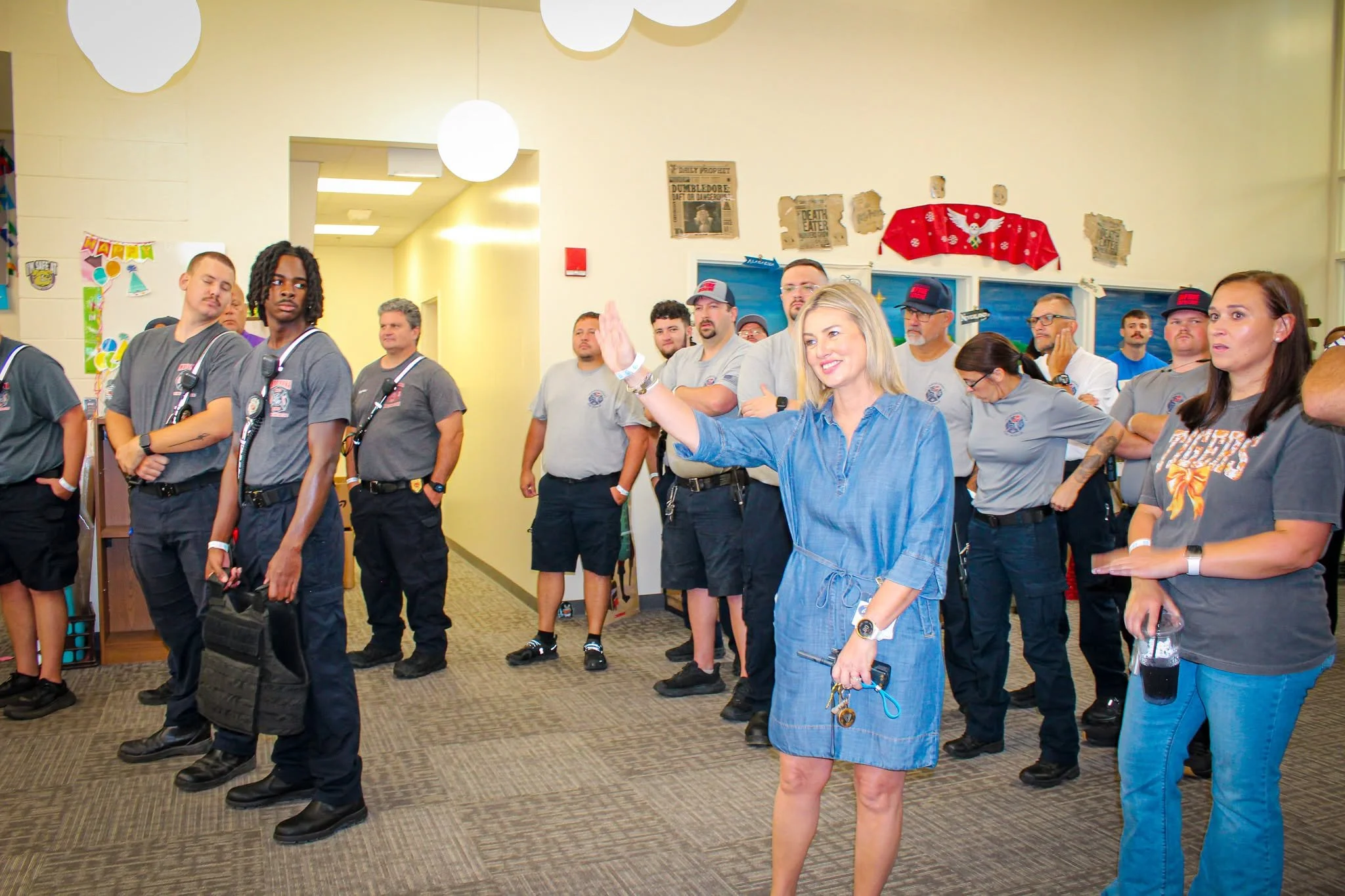
A push of a button set an entire emergency response system into motion at Marianna K-8 School, launching a carefully planned drill designed to answer one critical question: If the unthinkable happened, would Jackson County be ready?
The recent full-scale public safety exercise brought together school personnel, law enforcement officers, firefighters, emergency medical crews, emergency management officials, hospital representatives, aviation resources and numerous supporting agencies. Although the injuries, weapons and danger were simulated, the response was carried out as realistically as possible.
Jackson County Emergency Management Director Keith Maddox coordinated the wide-ranging exercise, which tested far more than the response inside one section of the school. The scenario extended from the first emergency alert and 911 calls to law enforcement’s arrival, medical triage, patient transport, hospital preparation, student tracking and the reunification of students with their families.
“It forces us all, and gives us an opportunity, to work together in real life and see where there are any issues or problems,” Maddox said.
The exercise involved the Jackson County School Board and Marianna K-8 staff, Jackson County Sheriff’s Office, Jackson County Fire Rescue, Marianna Fire Department, Jackson County Emergency Management, Jackson Hospital, Sunland, AirHeart, LifeFlight, the Florida Division of Emergency Management and the Florida Department of Corrections. The Jackson County Sheriff’s Office communications center handled the simulated 911 and radio traffic in real time.
Additional observers and evaluators included emergency management representatives from Calhoun, Gulf and Gadsden counties and members of the federal prison’s special operations team. Blood-bank availability was checked as part of the hospital response, and military aviation assistance was explored during the simulated escalation.
Maddox said the exercise grew from a similar event held last year at Malone School. The original goal was to test the school district’s response to a major emergency, including its ability to lock down or evacuate a campus, protect students and staff, communicate accurate information and reunify children with their families.
A school emergency places many systems under pressure at the same time, he explained, making it an effective way to evaluate preparations that could also apply to other large-scale incidents. Marianna K-8 presented an especially valuable challenge because of the size and complexity of the campus.
While the active portion of the exercise had to be confined to one area, it gave responders who do not routinely work at the school an opportunity to become familiar with the facility. Officers, firefighters, medical personnel and representatives from outside agencies were able to see the campus firsthand, knowledge that could save valuable time during a real emergency.
Maddox said organizers plan to rotate the annual exercise among schools in the district.
The drill also put Marianna K-8’s emergency alert technology to the test. Staff members carry an alert device with their identification cards. When activated for a serious emergency, the system can place the school in lockdown, sound alarms, trigger flashing lights and immediately notify dispatch, law enforcement and school personnel through phones and computers.
The system can identify the staff member who activated the alert and display that person’s location on a campus map, even tracking movement when necessary. Maddox said the technology performed very well during the exercise.
The day’s scenario involved two students who had concealed simulated edged weapons in band cases and attacked students and teachers. Twelve victims were included in the scenario, with participants wearing realistic simulated injuries and triage cards. More than 20 students were moved by bus to Marianna High School so the district could practice the reunification process.
That portion of the drill tested more than transportation and recordkeeping. Participants portrayed worried and frustrated parents arriving in search of answers, requiring school personnel to practice communicating under the same emotional pressure they could face during an actual crisis.
Inside the response area, deputies entered with training weapons and cleared the building. Once the scene was secured, fire and emergency medical personnel moved in under law enforcement protection to locate victims, assess injuries, assign triage categories and begin moving patients to the appropriate level of care.
Jackson County Fire Rescue Chief Charlie Brunner said the exercise allowed each participating department to examine its own performance while also strengthening cooperation among agencies.
“This event had every applicable agency involved,” Brunner said. “It gives us a chance to see how we reacted in simulated circumstances and what we need to improve in our department as far as communication, triaging and moving those patients where they need to be.”
Brunner said emergency response skills must continually be practiced and refined. “There’s always room to sharpen your pencil on those skills,” he said. “All the volunteers and all the agencies worked well together.”
He also thanked the Jackson County School District for fully opening the campus to responders and providing the access and support needed to make the exercise realistic and worthwhile.
While responders worked at the school, Jackson Hospital representatives participated in a related tabletop exercise. As the scenario unfolded, the hospital received simulated reports about the number of patients headed its way, including trauma alerts. Officials tested how quickly additional blood could be secured, and aircraft requests were made through dispatch to practice coordinating multiple air-medical resources.
The exercise also tested the ability to document where injured students and teachers were sent. In a large emergency, patients may be transported to several hospitals, making accurate tracking essential for medical coordination and for families desperate to learn where their loved ones have gone.
A separate but connected exercise took place at nearby Sunland. The facility was notified that a major event was unfolding at Marianna K-8 and that someone fleeing the area might arrive on its campus.
A student actor, covered in simulated blood but showing no injury, appeared at Sunland’s guard station claiming to be a victim. In the scenario, the student was actually one of the assailants attempting to escape by posing as an injured survivor. Sunland security personnel had to assess the situation carefully while exercising the facility’s own protective procedures.
The Florida Division of Emergency Management observed the exercise, and the State Watch Office was notified as it would be during a significant real-world incident. Evaluators and controllers from outside Jackson County watched the various parts of the response and recorded what worked, what caused difficulty and what could be made more realistic in future drills.
Those observations will be compiled into an after-action review. Leaders from each participating agency will meet to examine the findings, preserve the practices that worked and address shortcomings before they are tested by an actual emergency.
“That’s the ultimate goal,” Maddox said, “for everybody to go back to their respective agencies and fix any issues they have.”
No exercise can remove every uncertainty from a crisis, but this one allowed Jackson County’s responders to build familiarity, expose gaps and strengthen the working relationships that become indispensable when seconds count. The exercise’s success was not measured by a perfect performance. It was measured by the willingness of every agency involved to learn together now so they can serve and protect together when it matters most.
